

Emergency Preparations For Multi-Dog Homes - Fire Drills
If the smoke alarm went off at 4:00 in the morning, how would you get every dog out of your house?
Not eventually, after everyone finds shoes, looks for leashes and figures out who is taking which dog. I mean right now, with alarms going off, dogs becoming frightened, people waking from a dead sleep and possibly smoke, darkness, severe weather or emergency personnel adding even more chaos.
If you have one easygoing dog who follows you everywhere, your plan may be fairly simple. If you have four dogs, foster dogs, a flight-risk dog, a dog who will not allow a stranger to handle him, senior dogs who need physical assistance, or two dogs living in a crate-and-rotate situation because they cannot safely be together, emergency planning becomes considerably more complicated.
That is exactly why we think through these things before the emergency happens. We practice fire drills with children because nobody wants the first rehearsal to happen while a house is filling with smoke. I think people with dogs need the same mindset, especially when the household includes multiple dogs or dogs with behavior concerns.
An emergency does not make your normal dog-management problems disappear. If two dogs cannot safely be loose together on an ordinary Tuesday, they probably cannot suddenly be loose together because the smoke alarm went off. If your dog is a flight risk today, alarms, strangers and chaos are not likely to improve that.
Start With the Hardest Version of the Scenario
It is easy to make an emergency plan while imagining everyone is awake, dressed and conveniently standing beside the back door. That is probably not the version you need to plan for. Instead, picture the alarm going off at 4:00 a.m. One person may not be home. The power may be out. A frightened dog may hide. Another may refuse to come through a doorway. Two dogs may become highly aroused by the alarm, and a normally manageable dog may panic when firefighters or strangers enter the property.
Now ask yourself how you would get everybody out without creating a second emergency. You do not need to become paranoid about everything that could possibly happen. You simply need a plan that still has a reasonable chance of working when circumstances are not ideal.
Know Who Is Responsible for Each Dog
If more than one person lives in the household, decide ahead of time who is responsible for which dog. Do not rely on everyone figuring it out while the alarm is sounding. You may even need an evacuation order. The dog sleeping loose in the bedroom may be quick to leash and move, while another dog may need to come out of a crate, a senior may require physical help, and a dog with handling issues may need a particular person.
If incompatible dogs need to exit through different doors, in a particular order, or directly into separate crates in the vehicle, figure that out now. If there is only one person in the home, the question becomes even more important: what is the safest sequence for moving the dogs?
Your Plan Should Answer These Questions
- Who gets each dog?
- Which dog comes out first?
- Which exit will you use if the normal exit is blocked?
- Which dogs must remain separated during evacuation?
- Where does each dog go once outside?
- Who can safely handle each dog?
- Which dogs need special equipment?
- Where will the dogs go if you cannot return home?
Where Are the Leashes?
This sounds ridiculously simple until you picture yourself trying to find four leashes in a dark house while everyone is panicking. Keep emergency leashes where you can reach them quickly. Depending on your home, that may mean keeping one set near the primary exit and another near a secondary exit.
If you have a flight-risk dog who requires a particular harness, martingale, backup connector or other secure equipment, make that equipment part of the plan too. Check it periodically, replace worn equipment before it fails, and keep a backup leash and appropriately fitted collar or harness in your evacuation supplies or vehicle.
Do not make your emergency plan depend upon finding the dog's favorite walking leash buried under three raincoats in the hall closet.
Even If Your Dog Doesn't "Need" a Crate, Teach Crate Training Anyway
I hear this all the time: “My dog doesn't need a crate.” Maybe he doesn't need one during ordinary life. Maybe he sleeps loose, has beautiful house manners and has not been confined at home in years. That's fine.
That does not mean he will never need to be in one.
There are times in a dog's life when confinement may no longer be optional. An evacuation may require a dog to travel or stay in a crate. A temporary shelter, hotel, boarding facility or emergency housing arrangement may require one. Your veterinarian may need to kennel your dog before or after surgery or during hospitalization. An injury may require restricted activity. Someone else may have to care for your dog because you are unexpectedly sick, injured or unavailable. Repairs, movers, emergency personnel or another unexpected situation may make secure confinement the safest option for a period of time.
That is not the day I want your dog learning what confinement feels like for the first time.
Crate training is not only about preventing puppy destruction or house-training accidents. It is a life skill. Your dog may rarely need the crate, but when he does need it, the reason may already be stressful enough without adding panic over the crate itself.
A dog who has learned that a crate is a normal, safe place can be moved, transported and temporarily housed much more easily than a dog who believes confinement means something terrible is happening. That does not mean every dog needs to spend hours crated every day. It means the dog should know how to enter one, remain there comfortably for an appropriate period and come out without the entire experience becoming a battle.
If your adult dog has never been crate trained, you have not missed your chance. Start now, while there is no emergency. Let the dog explore the crate without pressure, feed meals or appropriate enrichment there, build short periods with the door closed, and gradually teach the dog that confinement is temporary and predictable.
Use the crate sometimes when nothing bad is happening. If the crate only appears immediately before you leave town, go to the veterinarian or disappear for six hours, the dog is going to notice the pattern.
Free Crate Training Guide
I have a free Crate Training Guide for Puppies and Dogs specifically to help pet parents teach this before the dog desperately needs the skill.
Crate-and-Rotate Homes Need a More Detailed Plan
If you live with dogs who cannot safely be together, emergency preparation becomes even more important. During ordinary life you already have a system: one dog is out while another is secured, and gates, doors, crates and routines prevent accidental contact. An emergency can blow that routine apart unless you have already decided how evacuation will work.
Do not assume that because the situation is urgent, the dogs will somehow ignore their conflict. High arousal, noise and frantic human movement may make an already difficult relationship even less predictable.
Do Not Create a Dog Fight While Escaping Another Emergency
If dogs have a serious conflict history, keep separation in the evacuation plan. That may mean designated handlers, different exits, separate travel crates, different vehicles, or securing one dog completely before moving the next.
This is exactly the sort of thing you should physically practice. A plan that sounds perfectly logical while sitting at the kitchen table can fall apart when you discover that two humans, three dogs and two crates cannot actually move through the doorway the way you imagined.
If you are already living with complicated household management, also read Dog Safety Protocols for Trainers, Rescues & Multi-Dog Homes. Your emergency plan should fit into the safety system you use every day rather than replacing those rules when things get chaotic.
Where Do the Dogs Go Once They Are Outside?
Getting everybody through the door is only half the plan. Now you may have several frightened dogs standing outside while sirens, flashing lights, firefighters, neighbors and unfamiliar vehicles are arriving. Your normal fenced yard may not be a safe holding area if emergency personnel need access, a gate must stay open, smoke is moving toward the property or part of the yard itself is involved in the emergency.
Whenever possible, I would rather have a plan that gets dogs into secure vehicles, travel crates or directly into the care of designated handlers who can move them away from the emergency activity.
Years ago, we used well-spaced fixed tether points as very temporary staging locations when one person needed to get several dogs out quickly. I would look at that differently today. A secure attachment point may still have value for a brief, actively attended transition in the right setup, but I would not build an evacuation plan around leaving dogs tethered outside. Conditions can change quickly, and the goal is to move the dogs away from danger and into secure transport or another safe location.
Have a Backup Person Who Actually Knows Your Dogs
What happens if the emergency occurs when you are not home? A trusted neighbor, nearby friend, family member or other designated person can be invaluable, but only if that person has access and understands the dogs they may be walking into.
If your dogs are easy to handle, this may be straightforward. If one dog is aggressive toward unfamiliar people, another is a major flight risk and two others cannot be loose together, handing the neighbor a key without instructions is not an emergency plan.
Your backup person needs to know which dogs they can safely handle, where equipment and crates are located, which dogs must remain separated, what exits can be used and where the dogs should go. Some dogs may not be safely manageable by that person at all, and that information matters too. Emergency personnel need accurate information rather than somebody getting bitten because no one mentioned the dog behind the bedroom door has a serious bite history.
Muzzle Conditioning Belongs in Emergency Preparation Too
If you live with a dog who has known human-directed aggression, serious fear, handling sensitivity or a significant bite history, I strongly prefer that the dog already know how to comfortably wear a basket muzzle before an emergency happens.
That does not mean the dog should live in one, and a muzzle never replaces appropriate handling or management. It simply gives you another familiar safety tool if the dog needs emergency veterinary care, transportation, temporary housing or handling by someone unfamiliar.
Just like the crate, a crisis is a lousy time to introduce a muzzle for the first time.
Practice the Fire Drill With Your Dogs
You do not need smoke machines, flashing lights or anything else designed to scare the hell out of the dogs. You are practicing the mechanics of getting everybody out safely.
Pick a day when nothing is wrong. Start wherever the household would normally be at night. Get the dogs, attach the equipment, move them through the planned exit and put them where they would actually go. If your plan is to load dogs into the vehicle, load them. If incompatible dogs need separate crates, practice that. If one person is supposed to handle two dogs, find out whether that is actually realistic.
Then try the secondary exit. Practice in daylight first, but eventually ask yourself whether the same plan works when people are sleepy and visibility is poor.
The purpose of a drill is not to test your dogs. It is to expose the weak points in your human plan while you still have time to fix them. You may discover that a crate does not fit through a doorway, one person cannot safely hold the dogs assigned to them, a backup leash is missing or your intended vehicle arrangement puts two incompatible dogs beside each other.
Practice Getting Into the Car
Some dogs ride in vehicles every week and think nothing of it. Others only see the car before veterinary appointments and require twenty minutes of negotiation before they will load. If your emergency plan includes a vehicle, your dog needs some familiarity with getting into it.
This becomes even more important for fearful dogs, very large dogs, senior dogs with mobility limitations and dogs who resist entering a travel crate or vehicle. You do not need every dog to adore road trips, but basic loading and transport skills make an evacuation considerably easier.
Prepare for the Possibility That You Cannot Go Home
This is one of the most important questions in the entire plan: what happens if you get every dog out safely and then learn that you cannot go back into your house?
You may be displaced for one night, or fire, smoke, water damage, hurricanes, flooding or another disaster may keep you away for considerably longer. Where are you going, and where are the dogs going?
If you have one social dog, finding a pet-friendly hotel may be inconvenient but manageable. If you have five dogs, two with aggression concerns and two who cannot be housed together, that is a different problem. Think about pet-friendly lodging, boarding options, friends or relatives who genuinely can manage your dogs, veterinary boarding when appropriate, and what you will do if your normal backup option is located inside the same evacuation area.
This is another place where crate training becomes important. Even if your dog is normally loose in your house, temporary housing may not offer the same freedom or setup. A dog who can calmly rest in a crate gives you more options when your normal home environment is suddenly unavailable.
Your Emergency Plan Is Bigger Than the Fire Drill
This K9Coach article is intentionally focused on the behavior, handling, crate training, evacuation mechanics and multi-dog management side of an emergency. There is another part of preparedness too: identification, veterinary information, medications, food, water, first-aid supplies, records and the actual dog go-bag.
I cover that side much more specifically at The WellOiledK9.
Build the Rest of Your Dog's Evacuation Plan
Use my companion article at The WellOiledK9 for the health and supply side of preparedness, including identification, medical information, medications, food, water, travel supplies and what to keep ready if you need to leave home quickly.
Build a Dog Evacuation Kit
You do not need to move the entire contents of your dog cabinet into a tactical backpack. You do want enough basic equipment, information and supplies that you are not trying to rebuild your dog's life from memory while displaced.
Consider Keeping These Ready
- Extra leashes.
- Backup collars or harnesses.
- Identification tags.
- Any necessary conditioned basket muzzles.
- A travel crate or carrier appropriate for the dog.
- Food and portable bowls.
- Water.
- Necessary medications.
- Basic first-aid supplies.
- Copies of important veterinary and medication information.
- Current photographs of each dog.
- Microchip information and registration details.
- Cleanup supplies.
- A list of emergency contacts and possible evacuation destinations.
- Important behavioral and handling information for anyone who may care for the dog.
Keep the kit somewhere accessible. An evacuation kit buried in the back of a closet behind the Christmas decorations is not nearly as helpful as it sounded when you assembled it.
For a much more complete look at what should be in the dog's evacuation supplies, use my Emergency Evacuation Plan for Dogs at The WellOiledK9.
Keep Identification Current
Emergencies create opportunities for separation. A frightened dog may slip equipment, bolt through an open door or become separated during evacuation or temporary housing. Keep identification tags current, and if your dog is microchipped, make sure the registry has your current phone number and contact information.
Current photographs of your dogs are useful too. If a dog becomes lost, you should not have to scroll through 9,000 pictures on your phone looking for the one photograph where the dog's entire body, coloring and markings can actually be seen.
Think About Medical and Behavioral Needs
Some dogs need more than food, water and a leash. A dog taking critical medication needs a medication plan. A senior dog may need assistance getting into a vehicle. A dog recovering from surgery may need restricted activity. A dog with extreme noise sensitivity may become particularly difficult to handle around alarms and sirens.
Behavioral needs belong in the emergency plan too. If your dog cannot be housed around other animals, bites when strangers reach for his collar, guards his crate, panics during handling or requires particular equipment, write that information down. Someone caring for your dog during a disaster needs to know more than his name and how many cups of food he eats.
Make the Plan Easy for Someone Else to Understand
If something happens to you during the emergency, could somebody else figure out your system? This matters enormously in multi-dog and higher-risk homes. You may automatically know that one dog goes through the garage while another remains behind a gate, that one dog cannot be boarded beside other dogs, or that another should never be grabbed by the collar. Somebody stepping into your household does not know any of that.
A simple written sheet can identify each dog, normal sleeping locations, medications, handling concerns, veterinarian, emergency contacts, necessary equipment and household separation rules. For rescue groups and foster organizations, this information should already be part of the dog's record. Emergency information that exists only inside one foster parent's head is vulnerable information.
What If You Are Suddenly the One Who Is Unavailable?
Not every emergency is a hurricane or house fire. Sometimes the emergency is you.
You may end up hospitalized unexpectedly. You could be injured, delayed away from home or simply unable to care for your dog for a period of time. Someone else may have to step into your routine with very little warning.
This is another reason I want dogs to have practical life skills beyond whatever they technically need on a normal day. A dog who can be handled on leash, enter a crate, tolerate temporary confinement and be cared for by an appropriate backup person has more options when life goes sideways.
You do not train those skills because you expect something awful to happen. You train them because dogs live a long time, circumstances change, and sometimes the dog needs to safely adapt to a situation none of us planned.
Do Not Go Back Into a Dangerous Structure for Your Dog
This is one of the horrible realities of fire emergencies. We love our dogs enough that many people instinctively want to run back inside if one is missing. If the structure is unsafe, tell firefighters or emergency personnel exactly which dog is missing, where that dog normally sleeps or hides, whether the dog may be crated and whether there is bite risk or another handling concern.
Do not create another person who needs to be rescued. This is another reason the preparation matters so much: reliable recall, leash handling, crate training, secure equipment and practiced evacuation routines give us more options before conditions become dangerous.
Check the Plan a Few Times a Year
Emergency plans get stale because households change. Dogs age, new foster dogs arrive, equipment gets moved, medications change, someone moves out or a new dog joins the household. The crate that used to sit beside the back door may now be in the garage underneath six boxes.
A few times a year, run through the plan again. Check leashes, crates, carriers, gates, evacuation supplies, medication information and contact numbers. Practice moving the dogs and make sure everyone still knows their role. If you have not put the travel crate up in two years, unfold it and make sure all the pieces are actually still there.
For Rescues, Trainers and Foster Networks
If dogs regularly move in and out of your care, emergency planning should not depend on whoever happens to be working that day knowing every animal personally. Identify dogs with special handling needs, flight risk, dog incompatibility or bite risk clearly. Know how many animals you can realistically evacuate with the people and vehicles available, and make sure crates, leads, carriers and emergency information are accessible.
Foster homes need plans too. A foster with six dogs and a crate-and-rotate setup may have a much harder evacuation problem than the organization's main facility realizes. Trainers boarding or housing dogs need to know how client dogs would be moved if the building had to be evacuated and which dogs cannot simply be turned out together in a fenced area.
This does not need to become a fifty-page disaster manual, but it needs to be considerably more useful than, “Call us if something happens.”
Training Makes Emergency Planning Easier
This is one of those places where very ordinary dog training suddenly becomes extremely practical. A dog who comes when called is easier to collect. A dog who willingly enters a crate is easier to transport and temporarily house. A dog who can move on a leash without completely losing his mind is easier to evacuate through chaos. A dog who is already muzzle conditioned has a familiar safety tool available if handling becomes complicated.
For dogs living with significant fear or aggression, we may never make every emergency situation comfortable. That is not really the goal. The goal is to give the dog and the humans as many familiar skills, tools and systems as possible before everything becomes unfamiliar at once.
You cannot control the emergency. You can control how many useful skills your dog already has when it happens. Crate training, leash skills, recall, handling tolerance, muzzle conditioning where appropriate and a practiced evacuation routine are not glamorous training exercises. They are the things you may someday be very glad you taught.
Run the Drill Before You Need the Drill
Tonight, look at your dogs and actually think through the scenario. If the alarm went off while everyone was asleep, who would get each dog? Where are the leashes? Can you safely move incompatible dogs without crossing paths? Which dog needs a crate? Where do the dogs go once they leave the house? Can everybody fit securely into the vehicle? What happens if you cannot come home, and who can safely help if you are not there?
If you cannot answer all of those questions yet, that is not a reason to panic. It is the reason to make the plan now, while you have the luxury of thinking it through.
Then practice it, because the middle of an actual emergency is a terrible time to discover that your dog has never been in a crate, your backup leash disappeared six months ago, or the system you thought you had does not actually work.
Continue With:
Dog Safety Protocols for Trainers, Rescues & Multi-Dog Homes →
Managing a Complicated Dog Household?
If aggression, fear, flight risk or dog-to-dog conflict makes everyday management difficult, an emergency plan is only one part of the picture. We can also look at the behavior itself, the household setup, your current safety system and what may realistically be improved.
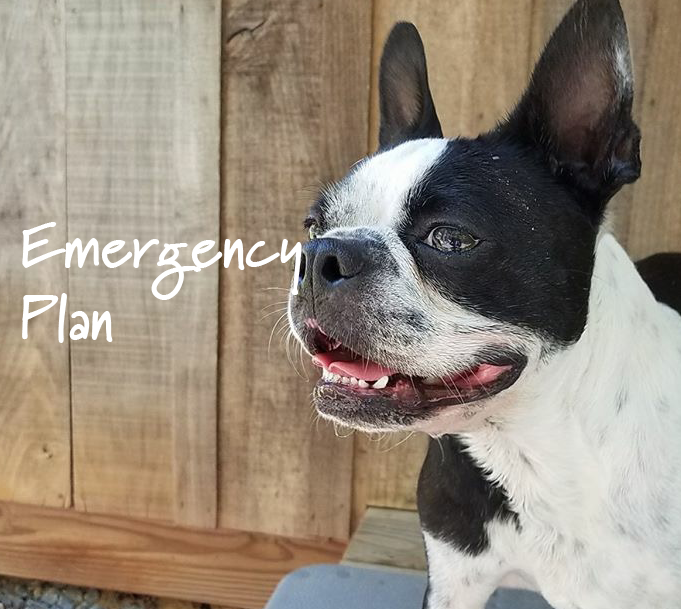
You need an emergency plan for your dog and to have fire drills just like you do with kids.
Need Help? Sometimes you need a coach and experienced pro to put the plan together for you Let me help you figure out what to do next. Behavior * Nutrition * Training * Natural Wellness * Recovery
Complete the Questionnaire For A Callback →