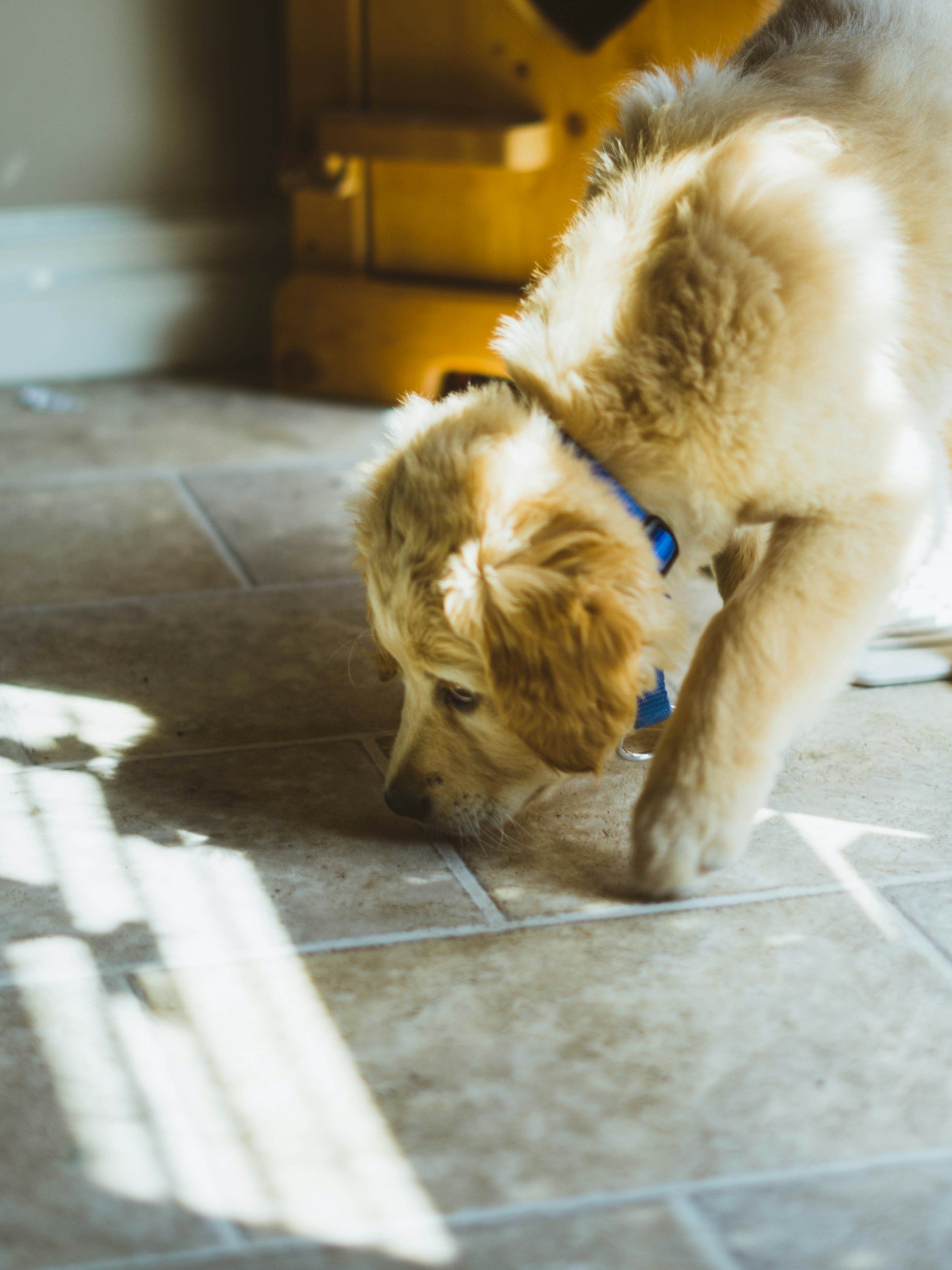
If your dog loves to sniff absolutely everything, congratulations. You already have the basic equipment needed for scent work.
Scent work — sometimes called nose work — takes something dogs naturally do every day and turns it into a game you can enjoy together.
You can start with something as simple as hiding food around the house and telling your dog to “Find it!” Or you can take it much further and learn formal scent detection, container searches, interior searches, outdoor searches and even competition scent work.
And before I teach you some games you can do at home, I want to say this right up front:
They are FUN. Not “I guess I should train my dog” fun. Actually fun. You get to watch your dog use an ability that is dramatically better than yours, learn how to read what their nose and body are telling you, and become a team in a completely different way.
What Is Scent Work for Dogs?
Scent work is a broad term for teaching a dog to search for and locate a particular odor, object, food item or person.
Formal dog scent work is based loosely on the type of detection work performed by professional working dogs. In the sport version, dogs learn to locate designated target odors and communicate to the handler when they've found them.
But your dog does not need to compete — or even use a formal target odor — to enjoy using their nose.
At home, scent games can be as simple as:
- Finding hidden treats
- Searching cardboard boxes
- Finding a favorite toy
- Locating a family member
- Searching for an object by name
- Following a short scent trail
- Learning formal odor detection
It's one of those activities that can grow right along with your dog. Start with three cardboard boxes in the living room and six months later you may find yourself standing in a parking lot watching your dog work odor like a little professional.
Why Scent Work Is So Good for Dogs
Dogs experience a tremendous amount of their world through scent. When we give them structured opportunities to use that ability, we're working with the dog instead of constantly asking them to operate like small furry humans.
Scent work can provide:
- Mental exercise without requiring miles of physical activity
- Enrichment for dogs who need more than another walk around the block
- Confidence-building opportunities through repeated successful searches
- A job for busy dogs who are always looking for something to do
- Low-impact activity for many senior dogs or dogs who can't participate in high-impact sports
- Teamwork because the human has to learn to watch and trust the dog
- A productive outlet for sniffing rather than treating every sniff as something to interrupt
And yes, working that brain and nose can be tiring. Ten focused minutes of searching can be far more mentally engaging than ten minutes of marching around the neighborhood.
Scent Work Is Different Because Your Dog Knows More Than You Do
This may be my favorite part.
In obedience work, you usually know the answer.
You know where heel position is. You know whether the dog sat. You know whether you asked for a down and got a down.
In scent work, you may not know where the hide is.
Your dog does.
Now your job changes. Instead of constantly telling your dog what to do, you have to watch:
- Where did the breathing change?
- Did the head suddenly turn?
- Did the dog double back?
- Did the tail or body posture change?
- Are they following odor or simply investigating the environment?
- What does your individual dog do when they know they've found it?
That is one reason a good scent work class is so valuable. A knowledgeable instructor can help you see behavior you didn't even realize your dog was showing.
How to Start Scent Work With Your Dog at Home
You do not need special equipment to introduce the concept.
I actually prefer to make the first few games ridiculously easy. The dog should quickly understand:
Using my nose makes good things happen.
Game 1: The Easy “Find It” Game
- Let your dog see you place a favorite treat a few feet away.
- Say “Find it!”
- Let your dog move to the food and eat it.
- Repeat several times.
- Gradually make the location less obvious.
This is not advanced scent detection. We're simply teaching the dog that “Find it” means use your nose and search.
Game 2: The Cardboard Box Search
This is one of my favorites because it's cheap, easy and scalable.
- Put three or four open cardboard boxes several feet apart.
- Place food in one box while your dog watches.
- Release your dog to “Find it.”
- After several successful repetitions, set the boxes up while your dog is out of the room.
- Bring the dog in and let the nose do the work.
As your dog understands the game, you can increase the number of boxes or change their positions.
Scent work is supposed to build problem-solving and confidence. If the dog spends every session frustrated and looking to you for the answer, you've made the puzzle too hard too quickly.
Game 3: Hide Treats Around a Room
Once your dog understands the search game, hide food in several easy locations around one room.
Think:
- Beside a chair leg
- Behind an open door
- Near the edge of a rug
- Beside a cardboard box
- On a low, safe surface
Then bring your dog into the room and say “Find it.”
Try not to point every answer out. Give the nose a chance to solve the problem.
Teach Your Dog to Find a Favorite Toy
You can also use scent work to teach object recognition.
Start with one favorite toy.
- Play briefly with the toy so your dog is interested in it.
- Give the toy a consistent name — “Ball,” “Duck,” “Rope,” whatever makes sense to you.
- Put the toy somewhere easy to find.
- Ask your dog to “Find Ball.”
- Reward successful finds with play, praise or whatever is meaningful to that dog.
Eventually you can add other objects and begin asking for a specific item.
Some dogs become surprisingly good at this.
What Is an Alert in Dog Scent Work?
An alert is the behavior that tells you your dog has located the target.
Dogs may naturally:
- Freeze near the source
- Stare at it
- Turn and look at the handler
- Sit
- Lie down
- Point with their nose
- Paw
- Bark
If you're simply playing scent games at home, don't get obsessed with manufacturing a fancy alert on day one.
First learn what your dog already does when they know they've found the thing.
Formal scent work classes can help you decide whether to preserve that natural alert or shape a more specific response.
What About Essential Oils for Scent Work?
Formal scent work sports may use specific target odors. For example, AKC Scent Work uses designated odors prepared on cotton swabs for the dog to locate.
That's very different from opening an essential oil bottle and sticking it under your dog's nose.
If you want to move from food searches into formal odor work, I strongly recommend learning the handling and setup from someone who teaches scent detection. How odor is prepared, stored and placed affects the search, and sloppy handling can contaminate everything around it.
The goal is for the dog to learn to locate an odor — not to saturate the environment with it.
Please Look for a Scent Work Class Near You
You can absolutely play nose games at home.
But if your dog enjoys this, go find a class.
Search for:
- Dog scent work classes near me
- Nose work classes for dogs near me
- Scent detection dog training near me
- AKC Scent Work classes near me
Check local dog training clubs and independent trainers in your area. You can also use the AKC Scent Work resources to learn more about clubs, classes and events.
Take the class because it's fun. Take it because your dog loves it. Take it because you'll learn things about how your dog thinks and communicates that you will never see while practicing another sit-stay in the kitchen.
If you eventually decide to compete, great.
If you spend six weeks laughing while your dog enthusiastically searches cardboard boxes and then you never enter a trial in your life?
Also great.
Can Reactive or Anxious Dogs Do Scent Work?
Sometimes scent work can be a wonderful activity for dogs who struggle with more traditional group activities.
But don't assume every group scent class is automatically appropriate for every reactive dog.
If your dog is uncomfortable around unfamiliar dogs or people, ask the instructor before enrolling:
- Are dogs worked one at a time?
- Where do dogs wait between searches?
- Are visual barriers available?
- How much space is there between dogs?
- Does the instructor have experience managing reactive dogs?
A well-run class may have dogs waiting safely in vehicles or separate areas while one dog searches at a time. That's very different from putting eight dogs shoulder-to-shoulder in a room and hoping everybody behaves.
Choose the environment that allows your dog to actually learn.
Is Scent Work Good for Senior Dogs?
It can be an excellent option.
Many senior dogs still desperately want something interesting to do even when their bodies no longer appreciate long hikes, repetitive ball throwing or high-impact sports.
A thoughtfully designed scent search can give that older dog a job while letting you adjust the physical demands to the dog in front of you.
Use easy footing, avoid unnecessary stairs or jumping, shorten sessions as needed, and let the nose do the heavy lifting.
Common Scent Work Mistakes
Making It Too Hard Too Fast
Your dog should experience plenty of success while learning the game. You can make searches harder later.
Showing the Dog Where Everything Is
If you point at every hide, eventually the dog learns to watch your hand instead of trusting their nose.
Talking Constantly
We humans love filling silence.
Sometimes the dog is working perfectly well until we start repeating “Find it, find it, over here, find it, what's this?” every three seconds.
Give your dog room to think.
Missing the Dog's Change of Behavior
Your dog's first “alert” may be subtle. Watch more than the nose. Look at the whole body.
Turning Every Session Into Obedience
Scent work is different.
Yes, your dog still needs manners and safety skills. But during the actual search, you want enough freedom for the dog to investigate odor and solve the problem rather than waiting for you to micromanage every step.
How Long Should a Dog Scent Work Session Be?
Especially in the beginning, short is plenty.
Five to ten minutes of focused searching may be more than enough for a beginner.
I'd rather stop while the dog is still thinking, “Can we do that again?” than drag the game out until the dog checks out.
As skills grow, you can work multiple short searches with rest in between.
Dog Scent Work Questions
How do I teach my dog scent work?
Start with an easy search using something your dog already values, such as food or a favorite toy. Let the dog learn that a cue such as “Find it” means to use their nose and search. Once that concept is clear, gradually make the searches more challenging. If you want to train formal target odors, a scent work class is an excellent next step.
What is the difference between scent work and nose work?
Pet parents often use the terms interchangeably to describe activities in which dogs use their sense of smell to locate something. Formal organizations and sports may have their own terminology, rules, target odors and competition formats.
Can any dog do scent work?
Most dogs can enjoy some form of scent game. The difficulty, environment and physical setup should be adjusted for the individual dog's age, mobility, confidence, health and behavior.
Is scent work good mental exercise for dogs?
Yes. Searching requires concentration, problem-solving and scent discrimination. Many dogs are pleasantly tired after focused nose work even though the activity may involve less physical exertion than running or long walks.
Is scent work good for high-energy dogs?
It can be a terrific addition to their routine. Physical exercise alone does not always satisfy a dog who also needs something productive to do with their brain. Scent work gives busy dogs a task that requires concentration rather than simply more speed and movement.
Can reactive dogs take scent work classes?
Some can, depending on how the class is structured. Ask whether dogs work individually, where they wait between searches and whether the instructor has experience accommodating reactive dogs. The setup is just as important as the activity.
Is scent work good for senior dogs?
Often, yes. Scent work can provide significant mental enrichment while allowing the physical demands to be adjusted for an older dog's mobility and stamina.
Do I need special equipment for dog scent training?
Not for basic games. You can start with food, toys and cardboard boxes. Formal odor work eventually requires appropriate scent materials and careful handling, which is another reason a good class can be helpful.
Where can I find dog scent work classes near me?
Search local dog training facilities and dog sport clubs for “scent work,” “nose work” or “scent detection” classes. AKC also provides Scent Work resources for locating clubs and events. Don't worry about whether you ever intend to compete — a beginner class can be worth taking simply because you and your dog enjoy it.
Let Your Dog Show You What That Nose Can Do
We spend an awful lot of time teaching dogs how to function in our world.
Scent work gives us a chance to step into theirs for a while.
Start with a few boxes. Hide some food. Say “Find it.” Then shut up for a minute and watch your dog work.
You may be amazed by what you've been walking around with at the other end of the leash.
And if your dog lights up when they understand the game, look for a scent work class in your area.
Seriously. Go have some fun with your dog.
Using the nose!