Resource Guarding in Dogs: Food, Toys, People & Bite Risk
Resource Guarding • Bite Risk • Multi-Dog Safety
Your dog freezes when you walk toward the food bowl. He grabs a sock and suddenly looks very different when you try to get it back. She stiffens over a bone when another dog enters the room. Maybe your dog growls when someone approaches the sofa, a favorite toy or even you.
Those behaviors often get grouped together as resource guarding, but the details matter.
What is the dog guarding? From whom? What happens before the growl? Does the dog simply move away with the item, or are we seeing freezing, hard staring, blocking, growling, snapping, charging or actual bites?
Resource guarding can be relatively mild. It can also become a serious bite-risk problem.
I do not want a dog mom panicking because her dog carried a chew into another room. I also do not want her repeatedly reaching toward a bowl or bone to “show the dog who's boss” when that dog has already made it clear that teeth may be involved.
The first goal is not winning the resource. The first goal is preventing an unnecessary bite while we figure out what we are actually dealing with.
Resource Guarding Is Not Really a DIY Problem Once Safety Is In Question
If your dog has already bitten a person, fought another dog over resources, guards multiple things, charges people away from an item or lives with children who could become part of the conflict, I would not build the plan from random internet tips.
The stakes are different once teeth are involved.
What Is Resource Guarding?
Resource guarding means a dog is trying to maintain access to something the dog considers valuable.
Food is the example most pet parents recognize quickly, but the guarded resource can be almost anything.
Food & Edibles
Food bowls, meals, chews, bones, treats, food dropped on the floor, stolen food or sometimes even an empty bowl associated with meals.
Toys & Objects
Balls, stuffed toys, sticks, tissues, socks, trash, paper towels or whatever bizarre treasure your dog has decided is suddenly priceless.
Space
Beds, couches, crates, resting areas, doorways or another location the dog does not want a person or another animal entering.
People & Social Access
A dog may threaten another dog or person approaching someone they value. I evaluate these cases carefully because anxiety, reinforcement history, relationship patterns and household conflict may all be part of the picture.
The object itself matters less than the dog's perception of value.
One dog may willingly walk away from dinner but become extremely serious about a stolen tissue. Another could not care less about toys but becomes dangerous if another dog approaches a chew.
Resource Guarding Does Not Always Start With a Growl
Learn the quieter signs.
The dog's body may become still when you approach. The head may lower over the item. The dog may eat faster, turn away with the object, move it farther from you, block with the body or give you a very specific sideways look.
You may see:
- freezing or sudden stillness;
- hard staring or what many pet parents call the “stink eye”;
- hovering over the resource;
- eating faster when someone approaches;
- moving the item away;
- blocking another dog or person;
- a closed, tense mouth;
- growling or lip lifting;
- snapping;
- charging; or
- biting.
I do not need to wait for the bite before deciding the dog is telling us something important.
Do Not Turn the Food Bowl Into a Power Struggle
One of the worst pieces of old advice around resource guarding was the idea that humans should repeatedly put their hands into the dog's meal, remove the bowl, take bones away and generally prove that the person owns everything.
If the dog was already concerned about losing valuable things, constantly taking those things can confirm the dog's concern beautifully.
I absolutely believe dogs need boundaries, obedience and rules.
I simply do not believe every meal needs to become an unnecessary confrontation.
Do Not Correct the Warning and Ignore the Problem
I do not want to teach a dog that growling is the only thing they did wrong.
A growl, freeze, hard stare or lip lift gives us information before teeth arrive. If we focus exclusively on silencing the warning while leaving the underlying conflict untouched, we may end up with less warning rather than less risk.
That does not mean the dog gets to control the household with threats.
There is a difference between respecting the information in a warning and allowing a dog to ignore trained behavior.
Once a dog understands OUT, LEAVE IT, recall away, Place or another relevant skill, I expect the dog to respond to that known communication. But I teach those skills before putting the dog into the highest-stakes resource conflict imaginable.
The Stolen Sock Problem
Stolen objects create a perfect recipe for teaching resource guarding.
Dog grabs sock. Human sees sock. Human chases dog. Dog runs. Human reaches. Dog clamps harder. Everybody becomes more emotionally invested in the sock than anyone has ever been in the history of laundry.
Then the dog learns that stealing something creates an exciting chase and that the human approaching predicts losing the treasure.
I want an OUT that means anything in the mouth can be given up.
In training, I may give an object back and continue the game so OUT does not automatically predict that all fun disappears forever. When play or access is actually finished, I can mark that with “all done.”
I also teach LEAVE IT and recall away from resources so the dog has more than one familiar way to disengage.
Trading can be useful when a setup has failed or you suddenly need to retrieve something dangerous. I simply do not want the entire training plan to become a dog learning that stealing increasingly ridiculous objects earns better and better snacks.
Teach Skills Before You Need Them
Do not wait until the dog has a cooked chicken bone, medication, a dead animal or the world's most valuable chew before discovering whether OUT works.
Practice when the stakes are low.
Useful skills can include:
- OUT — release what is in the mouth;
- LEAVE IT — disengage before taking the item;
- recall away — move away from the resource;
- Place — move to a defined location when needed;
- Wait — pause before meals or access;
- release cues — clear permission to access food or another resource;
- “all done” — clear communication that access or play has ended.
These are not party tricks. They are useful household communication.
Food Guarding Needs a Predictable Routine
I want meals to be boring in the best possible way.
Food is prepared. The dog follows the familiar routine. The bowl goes down. The dog is released to eat. The dog is allowed to finish without somebody repeatedly reaching into the meal.
If another dog creates tension around food, feed separately.
If children are present, the dog eats where children cannot approach.
If the empty bowl itself triggers guarding, pick it up when the dog is finished and has moved away rather than leaning over the dog to snatch it.
Predictability reduces unnecessary conflict.
Children and Resource Guarding
Children should never be responsible for proving that a resource-guarding dog has learned a lesson.
Children are fast, unpredictable and often face-level with a dog. They also reach for exactly the thing everyone told them not to touch.
Feed the dog away from children. High-value chews happen behind a secure barrier. Children do not retrieve stolen objects. Children do not take the dog's bowl. Children do not test whether the dog is “better now.”
If a dog has snapped at or bitten a child over a resource, stop treating this as an experiment.
That is professional-help territory.
Multi-Dog Homes
When One Dog Guards From Another Dog
Dog-to-dog resource guarding can begin around one obvious item and then spread into a much larger relationship problem.
If food creates tension, feed separately.
If bones or toys trigger conflict, those resources do not remain on the floor during shared time.
Bowls are picked up when meals are finished.
Do not leave an attractive resource sitting in an empty crate where another dog can approach it later.
If fights have already occurred, the dogs are not simply turned loose together because everyone has had a few quiet days.
Early reintroduction may require structured crate-and-rotate, leashes, physical barriers and, when appropriate, a properly conditioned basket muzzle on the dog presenting the greater bite risk.
Shared time needs supervision. Each dog also needs appropriate one-on-one time without constantly competing with the other dog for access, space or attention.
If guarding has progressed into actual household fights, continue with Dog-to-Dog Aggression in the Home .
What If My Dog Guards Me?
Dogs can become possessive around access to people.
A dog may wedge between family members, threaten another dog approaching Mom, growl when a spouse sits beside the owner or become defensive when someone reaches toward the dog while the dog is lying against a person.
I do not automatically interpret every one of those cases as the dog treating the person exactly like a food bowl.
Social behavior can be more complicated. Anxiety, reinforcement history, positioning, household relationships, conflict between dogs and learned patterns may all contribute.
What I would not do is romanticize threatening behavior as “he's just protecting Mom.”
If the dog controls who can approach you with a growl, snap or bite, the behavior needs to be evaluated for what it actually is.
A Basket Muzzle Can Be Part of the Safety Plan
A properly fitted basket muzzle may be appropriate when bite risk is real.
For some dogs, it may be part of daily life for a while rather than something worn only during an emergency.
A useful basket muzzle needs to allow the dog to pant normally, exercise, drink and accept food appropriately. It should be conditioned before the dog is placed into the exact situation that already creates conflict.
A muzzle does not make an unsafe setup safe enough to stop paying attention. It is another layer.
Management Is Necessary — But Management Alone Eventually Fails
This is the part people do not like hearing.
Gates get left open. Someone forgets the chew is under the couch. A child drops food. A visitor walks into the wrong room. Somebody assumes the dogs have “been doing great” and loosens the rules.
Humans are human.
So yes, use management. Use crates, gates, closed doors, leashes, tethers, feeding separation and muzzles when appropriate.
But if your dog is capable of causing injury, I do not want the entire safety plan resting on every person making every management decision perfectly forever.
Management buys us safety and training space.
It is not a substitute for teaching the dog usable skills and honestly evaluating the level of risk.
What About Corrections or an E-Collar?
An e-collar should never be introduced as a punishment button for resource guarding.
If an e-collar is part of a dog's broader training, the dog first needs separate, appropriate conditioning so the communication is understood. Correcting a dog around a resource without that foundation — especially when fear, conflict or bite risk is already present — can make the situation worse.
The same distinction applies to leash or verbal corrections.
I may correct refusal of a trained command.
I do not want someone randomly punishing a growl while standing over a dog who believes they are about to lose something valuable.
Those are not the same training situation.
What If Resource Guarding Started Suddenly?
A new behavior deserves a new question: what changed?
Look at the household and environment, but also consider pain, mobility, digestive discomfort, sensory changes, cognitive change, medications or another health issue that may have lowered the dog's tolerance.
A dog who suddenly growls when someone approaches the couch may have a behavior issue. The dog may also hurt when getting up.
Those possibilities are not mutually exclusive.
How Do I Know Resource Guarding Is Improving?
I am looking for much more than “the dog didn't bite today.”
Depending on the individual dog, progress can include:
- looser, more neutral body language around previously sensitive situations;
- less fixation on another dog or person approaching;
- no hard stare, hovering or posturing;
- reliable response to trained OUT, LEAVE IT or recall-away cues;
- the ability to disengage without conflict;
- faster recovery after something valuable appears;
- less need for handler intervention; and
- ideally, the dog beginning to check themselves and disengage before being told.
Progress does not mean we throw every previously guarded object on the living-room floor and see what happens.
Freedom expands because behavior demonstrates that it should.
Things I Would Stop Doing Today
- Stop repeatedly taking the dog's food bowl just to prove you can.
- Stop putting your hands into meals to “prevent guarding.”
- Stop sending children to retrieve objects from the dog.
- Stop feeding dogs side-by-side when meals already create tension.
- Stop scattering high-value chews around dogs who have fought over them.
- Stop chasing the dog through the house over stolen objects.
- Stop intentionally provoking guarding to see whether it is fixed.
- Stop forcing dogs to share resources they have already demonstrated they cannot safely share.
- Stop minimizing bites because they “only happen around food.”
- Stop assuming a few quiet days means every safety layer can disappear.
When I Would Stop DIY-ing Resource Guarding
I would seek individual help when:
- the dog has bitten a person;
- dogs in the household have fought;
- a child is involved or regularly visits the home;
- the dog guards multiple resources;
- the guarding is becoming more intense or spreading;
- the dog charges rather than simply warning;
- the bite caused punctures or significant injury;
- you are afraid to retrieve something from your own dog;
- another dog is living under constant social pressure;
- the behavior appeared suddenly; or
- aggression is showing up outside resource situations too.
I want the whole bite and behavior history — not simply, “He guards food.”
Who approached? What was guarded? What warning occurred first? Was the person reaching? Did the dog make contact? Was there a puncture? Did the dog release or continue? Has this happened before?
Those details change the risk assessment.
If aggression is occurring in several different situations, also read Living With an Aggressive Dog .
Questions Dog Parents Ask About Resource Guarding
Why is my dog suddenly guarding food?
First look at what changed. Consider household routines, other animals, access to food and recent experiences, but also consider pain, digestive discomfort, aging, sensory changes or other physical issues if the behavior is genuinely new.
Should I take my dog's food away to stop resource guarding?
Repeatedly removing food to prove that you can may create additional conflict, particularly with a dog already worried about losing a resource. I prefer predictable meal routines, useful trained communication and a plan based on the dog's actual level of risk.
Should I punish my dog for growling over food or toys?
I do not want to punish away useful warning information while leaving the reason for the warning unchanged. Make the situation safe, understand the conflict and teach appropriate behavior. Once a dog understands a trained cue, refusal of that known cue is a different issue from simply punishing the warning.
Why does my dog guard me from my other dog or spouse?
Guarding access to a person may involve possessive behavior, anxiety, learned patterns, household conflict or relationship dynamics. I do not romanticize threatening behavior as protection. If a dog controls who can approach you through growling, snapping or biting, it deserves a closer behavior evaluation.
Can dogs that fight over resources live together safely again?
Sometimes, but the answer depends on the dogs, severity of the fights, triggers, injuries, predictability and whether the household can safely manage a structured reintroduction. Once actual fights have occurred, I treat this as household dog aggression rather than a simple food-bowl issue.
Should my resource-guarding dog wear a muzzle?
A properly fitted and conditioned basket muzzle can be an important safety layer when bite risk is real. It should allow appropriate panting, drinking, movement and reward delivery. A muzzle does not replace supervision, training or appropriate management.
What do I do when my dog steals something and will not give it back?
Avoid turning every stolen object into a chase. Build a reliable OUT, LEAVE IT and recall-away response during lower-stakes practice. Trading can be useful when a setup fails or the item is dangerous, but it should not be the only communication the dog understands.
When does resource guarding need professional help?
Bite history, dog fights, children, escalating behavior, guarding of multiple resources, puncture wounds, fear of your own dog or guarding that extends beyond one predictable situation are strong reasons to stop experimenting and get individual help.
Want Practical Behavior Resources?
My behavior and real-life skills library includes practical guides and protocols as they are completed and released.
Browse Guides & ProtocolsAre Your Dogs Fighting Over Resources?
Once guarding has progressed into fights between dogs living in the same home, the relationship and household safety plan need a much broader look.
Read About Household Dog AggressionWhen Teeth Are Already Part of the Conversation
You Do Not Need to Win a Fight Over the Bowl
You need a dog who can live around valuable things without someone getting hurt.
If your dog has already bitten, dogs in your home have fought, your child is part of the risk or guarding is expanding into more areas of daily life, I would rather review the actual dog and household than have you keep testing ideas until something goes badly.
Video is often extremely useful. I can review body language, setup, household patterns and what happens before the guarding without deliberately provoking the dog for an appointment.
Explore Individual Behavior Support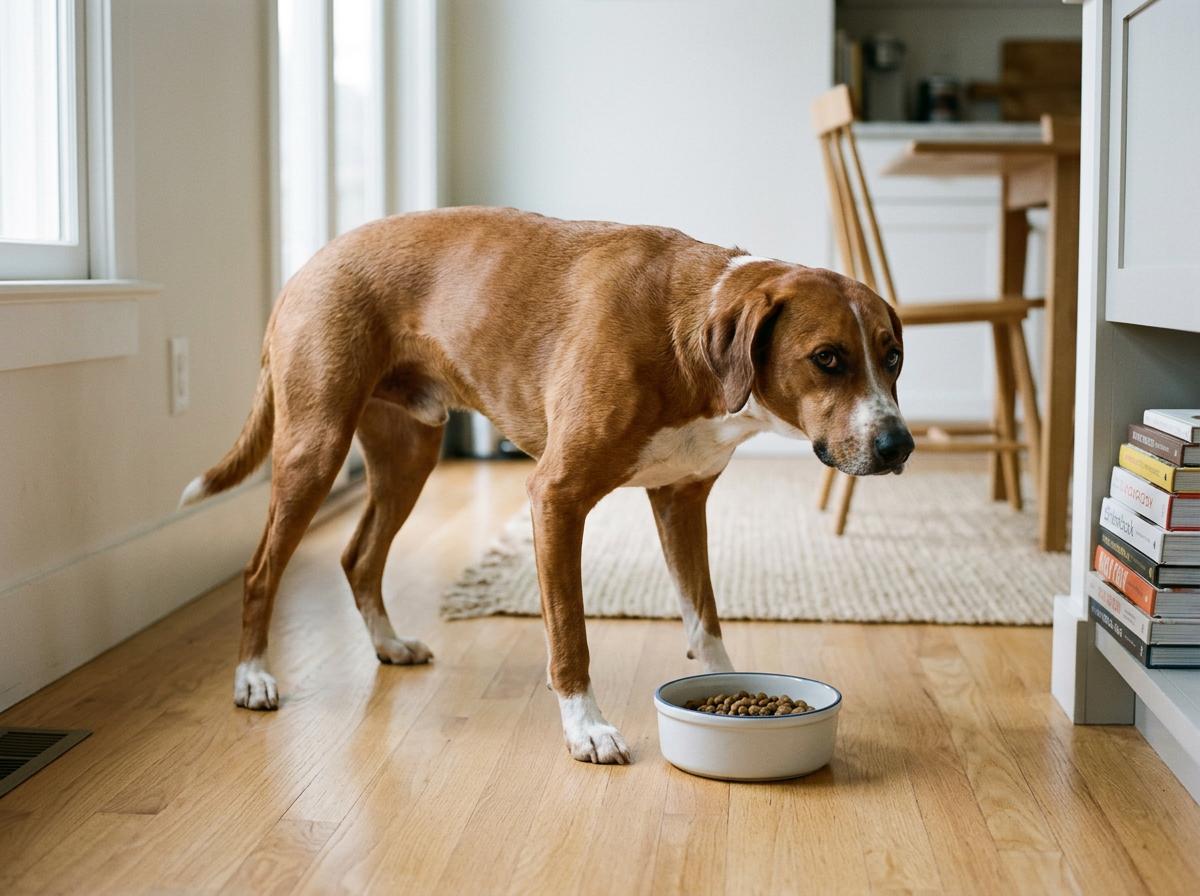
Need Help? Sometimes you need a coach and experienced pro to put the plan together for you Let me help you figure out what to do next. Behavior * Nutrition * Training * Natural Wellness * Recovery
Complete the Questionnaire For A Callback →